
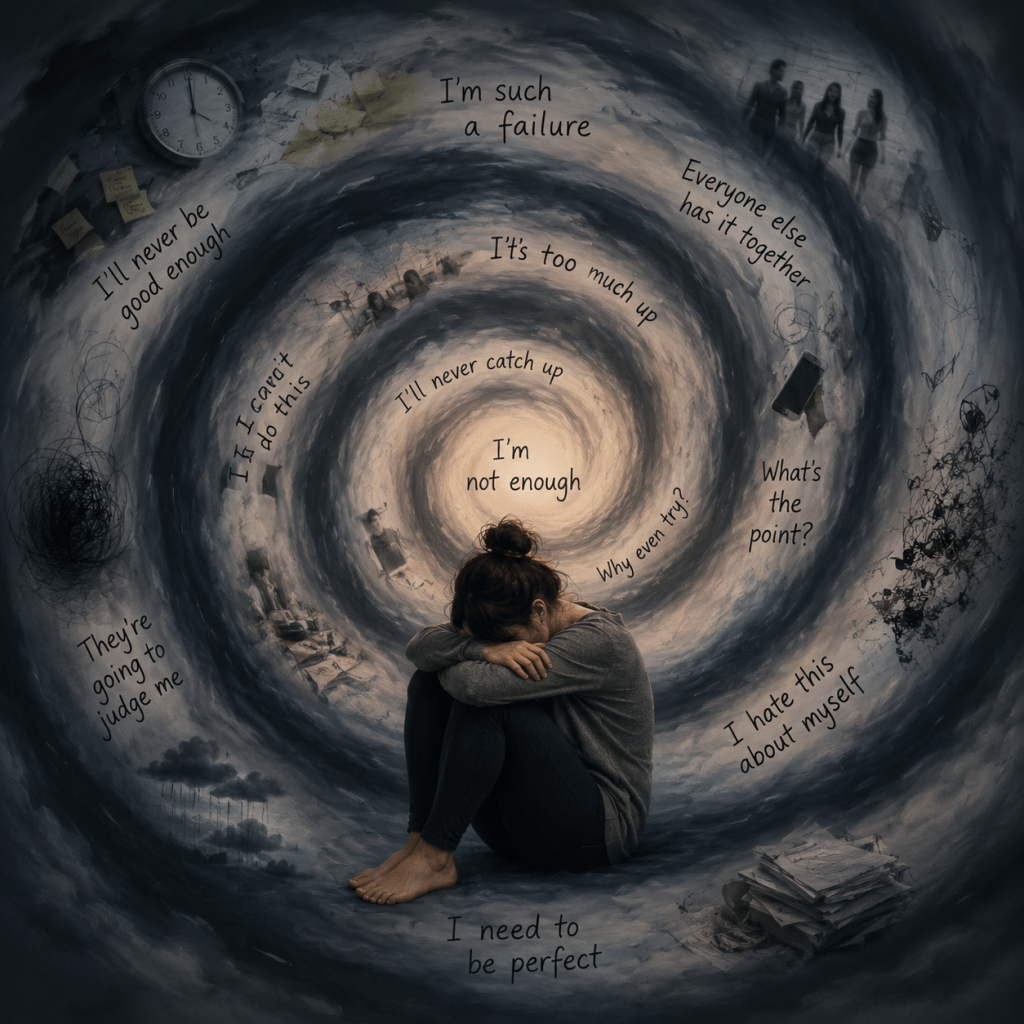
I have made so much progress in how I react to things out of my control, and yet, sometimes, I still take a step backwards. Even though the school year just began 1.5 weeks ago, I began thinking about the what-ifs and the different scenarios. All of a sudden, I started feeling that familiar tension in my stomach, my chest beginning to tighten, and instead of becoming sleepy and ready for bed, I was wide awake. All because a colleague casually texted and mentioned school.
An emotional spiral is a response to a seemingly small trigger, but then leads to racing thoughts, intense emotions, shutdown, avoidance, or conflict. These are very common for neurodivergent adults and overwhelmed caregivers. Emotional spirals are not character flaws—they’re often nervous system responses.
This article will explain why they happen and practical ways to interrupt them so you can continue with things you enjoy or need to do.
What Is an Emotional Spiral?
The difference between feeling upset and spiraling
Usually when you are feeling upset, you are able to pinpoint the cause. It is possible you may be upset with yourself or it could be you are upset with someone else. Typically you can work through your feelings and move on in a relatively short amount of time.
Emotional spirals are much bigger in magnitude. What may be a small issue suddenly turns into the end of the world. Your emotional response is much bigger for a smal issue. And you can’t let it go-every time you think you have gotten over it, it returns. You constantly think about it and pick the issue apart, continuing to wind yourself up emotionally.
Common signs you’re entering a spiral
- Catastrophic thinking
- Self-criticism
- Rumination
- Urgency to “fix” everything
- Emotional flooding
- Difficulty thinking clearly
Why Emotional Spirals Happen More Often in Neurodivergent Adults
ADHD and emotional dysregulation
ADHDers have a harder time managing emotional responses due to differences in their frontal lobe.
Autism, sensory overload, and nervous system overwhelm
When your nervous system is already at the saturated point, one more thing is likely to make emotions spill over.
Chronic stress and burnout lower emotional resilience
If you are burned out and already exhausted, you don’t have a high capacity to deal with things, even if they are small.
Rejection sensitivity and perceived criticism
Years of constant correction and being “too much” has left you sensitive to anytime you make a mistake.
Executive dysfunction makes problem-solving harder under stress
You can either bottle your emotions up, or you can find your planner, but not both.
Recognizing Your Personal Spiral Pattern
If you can recognize it, you can hopefully decrease your response before it gets out of control. The first step is to recognize your own personal triggers.
Common triggers
- Conflict
- Unexpected changes
- Feeling like you’ve disappointed someone
- Too many demands
- Sensory overload
- Lack of sleep
- Decision fatigue
Early warning signs
- Physical sensations
- Thought patterns
- Behavioral changes
How to Stop an Emotional Spiral Before It Grows
Step 1: Notice what’s happening without judging yourself
How is your body feeling in this moment? Try to identify any somatic symptoms.
Step 2: Regulate your nervous system first
Whether it’s stepping out of a busy room or putting on noise-cancelling headphones, make sure that you regulate your nervous system above all.
Step 3: Slow the story your brain is telling
This is a big one. Your brain may be picking out all of the negative things. Try to find objective data to support the actual story (for example, if you told yourself that your boss hates you, what proof is there to support that? What proof do you have that supports the opposite view point?)
Step 4: Reduce demands instead of pushing harder
Step 5: Choose one tiny next step
Start small. Choose a small step to take to help yourself feel better.
Nervous System Regulation Strategies That Actually Help
Movement
Movement is a great way to reduce tension and discharge extra energy or emotions.
Breathing exercises
When we are upset, our breath becomes very shallow. Breathing exercises help us take the deep breaths we need to get more oxygen and to regulate our nervous systems.
Sensory supports
Give yourself transition time, filter loud noise, or step into an empty room, whatever you need to regulate your sensory input.
Hydration and nutrition
These are so often overlooked! But think about it-if someone is “hangry”, don’t they need to eat? Proper food intake and hydration helps to balance moods.
Time outdoors
Fresh air and sunlight are mindfulness activities that help regulate your nervous system.
Co-regulation with another person
Talking with a trusted friend of family member can offer a fresh perspective and give you a chance to vent your emotions safely.
Thoughts That Keep Emotional Spirals Going
- All-or-nothing thinking-focus on consistency, not perfection
- Catastrophizing-remind yourself that you are safe.
- Mind reading-you can’t read someone’s mind and completely understand what was meant by that comment.
- Perfectionism
- Shame-based thinking-no one is perfect, you don’t need to continually punish yourself.
What to Do If You’re Already in the Middle of a Spiral
What not to do
- Force yourself to “just calm down”
- Make major decisions
- Doomscroll
- Continue arguing
- Ignore basic needs
What helps instead
- Pause
- Reduce stimulation
- Meet physical needs
- Give yourself permission to recover before solving
Building a Life with Fewer Emotional Spirals
Including some consistent strategies will better help regulate your emotions and decrease the chance of spirals. These include:
- Consistent sleep routines
- Protein and regular meals
- Lowering chronic stress
- Boundary setting
- Recovery time
- Therapy or coaching-especially if none of the above strategies help or emotional spirals increase in frequency and/or magnitude!
- Identifying recurring triggers
Conclusion
- Emotional spirals are a nervous system response, not a personal failure.
- Progress comes from recognizing patterns earlier—not never having big emotions.
- Small, compassionate interventions practiced consistently can shorten spirals over time.
- Choose one strategy from the article to try this week and focus on it, rather than attempting everything at once.


Leave a Reply